Why Anti-Aging is the Ultimate Health Secret
อ่านต่อ →
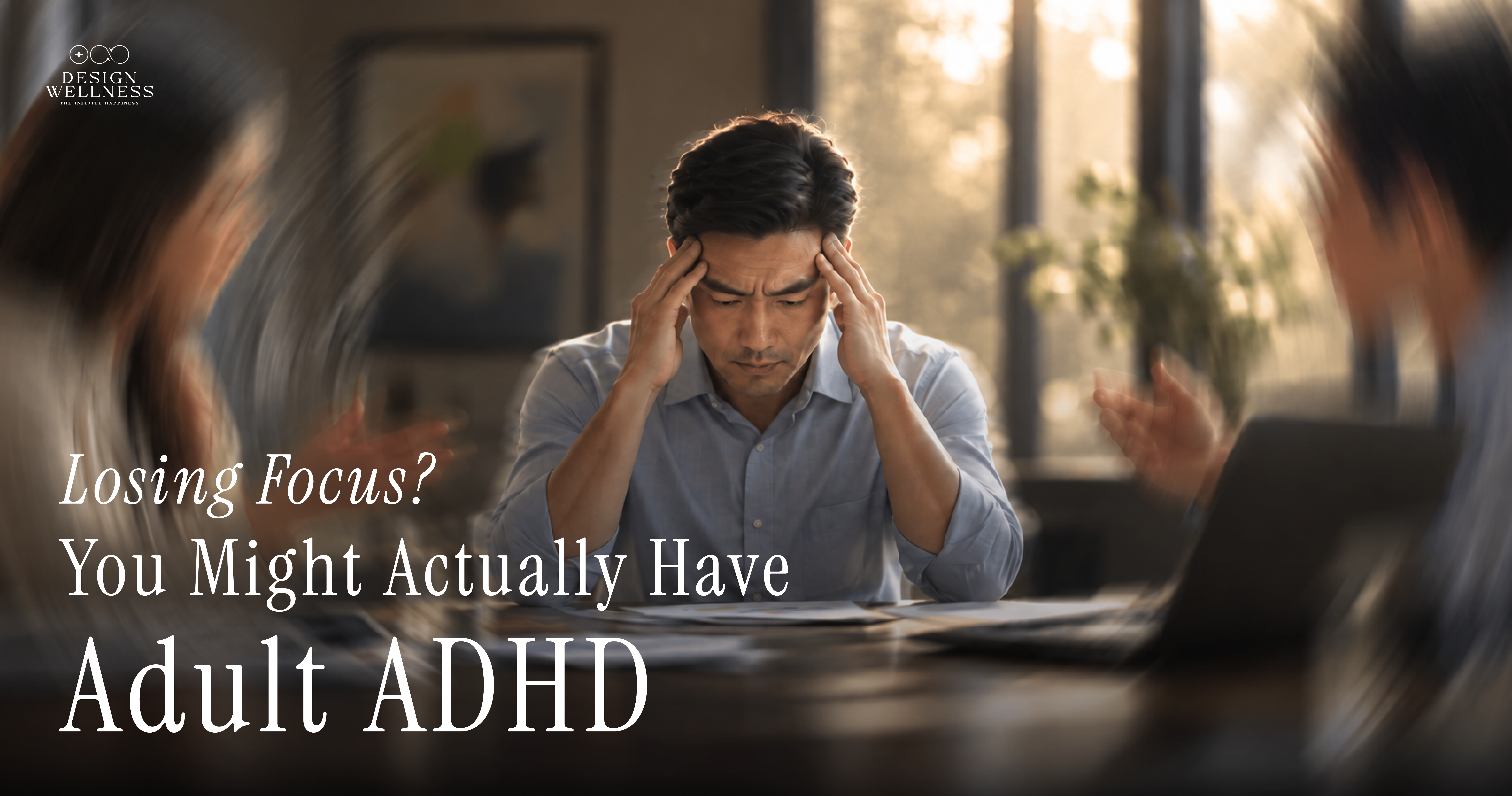
Even a small loss of focus can take a toll on both the quality of your decisions and your quality of life over time. Brain fog and drifting attention during the day aren’t always just the result of working hard. For executives and high-responsibility professionals, they may be warning signs of adult ADHD hiding beneath everyday fatigue. In this article, Design Wellness takes a deep dive into the root of the problem, so you can tell for sure whether what you’re experiencing is temporary exhaustion or a sign that something in your brain is out of balance.

That imbalance in the brain is, in fact, adult ADHD: a shortfall in the neurotransmitter dopamine in the prefrontal cortex, the part of the brain that governs attention and decision-making. Contrary to what many people believe, it isn’t a personality quirk like forgetfulness or a lack of discipline.
Interestingly, more than 65% of children with ADHD continue to have symptoms into adulthood, though in a different form. If you often mismanage your time, get distracted easily, or leave important work half-finished for more than six months, to the point that it affects your work and relationships, that isn’t a sign of being unprofessional. It’s a neurological condition that needs the right care and rebalancing, so you can manage your life and business well again.

All too often, the exhaustion that comes from overwork becomes a smokescreen that keeps us from noticing the signs of adult ADHD. These symptoms blend so seamlessly into daily routines that busy executives and professionals tend to brush them off with “I’ll be fine after some rest.” Take a step back and ask yourself whether what you’re experiencing actually matches these warning signs:
When rest isn’t the final answer. What separates these symptoms from ordinary tiredness is persistence. Brain fog and burnout usually improve with enough rest, but if the symptoms remain even after a full night’s sleep and real efforts to reduce stress, it’s time to suspect something more than everyday fatigue. Recognizing the signs and starting recovery early is the best way to protect your brain and body from premature decline.

Beyond the neurological condition described above, rapid-fire scrolling, or “dopamine scrolling,” is a silent threat of the digital age that quietly creates “pseudo-ADHD,” sometimes called “fake ADHD,” in working adults. Constant exposure to stimulating content causes abnormal dopamine release, until the nervous system becomes hooked on short bursts of pleasure and loses its capacity for deep focus. On top of that, screen addiction often leads to poor sleep, too little rest, and an unhealthy lifestyle, all of which inevitably speed up cellular aging and weaken the immune system.

When the brain is rewarded with instant gratification from endless scrolling, the nervous system is trained to crave speed and gradually loses its boredom tolerance. The numbers make the problem clear: research found that in 2004, people could focus on a single screen for about 2.5 minutes, but by 2020 that figure had plunged to just 47 seconds. On top of that, the average person picks up their smartphone to check it 96 times a day.
What’s worrying is that every time your attention is pulled away, it takes your brain an average of 23 minutes to fully refocus. When this cycle repeats every day, deep, focused work becomes a real struggle. Screen addiction also tends to lead to inadequate rest and an unhealthy lifestyle, both major drivers of stress and anxiety that make your cells age faster than normal.
The key difference that clearly separates these two conditions is when the symptoms began. Here’s how to tell them apart:
Heavy social media use doesn’t cause clinical ADHD, but it does suppress activity in the prefrontal cortex (the same area where differences are found in people with ADHD), leading to a measurable drop in the ability to concentrate. The good news is that a 2022 study found people who took just a one-week break from social media saw improvements in their mood and quality of life, although these benefits faded without long-term behavior change. Becoming aware of the problem, giving your brain a break from overstimulation, and managing stress are the essential first steps toward recovery through preventive medicine.

Many adults are slow to recognize the problem because ADHD in working adults doesn’t show up as the restlessness seen in children. Instead, it shifts into “mental restlessness”: a mind racing with so many thoughts at once that it never gets a break, something the people around you can’t see.
Adults also tend to build “compensation strategies” to hide their limitations, such as working around the clock to keep up and cover their mistakes. From the outside, they simply look like workaholics who are understandably tired. Relying on these strategies for years keeps the problem hidden until it spills over into every part of life:
Rather than relying on medication or simply pushing through brain fog, the most sustainable solution is to find the real cause. Lapses in focus, mood swings, and chronic stress are all signals that your body and brain are out of balance. That imbalance can stem from many factors, from sleep quality and hormones to deficiencies in the nutrients your body needs to produce neurotransmitters like dopamine.
Restoring your nervous system to full performance can’t rely on a one-size-fits-all formula. It has to start with personalized health testing to pinpoint where your health is really falling short, so your care and recovery plan can target exactly what you need.

A sharp mind and a healthy body don’t happen by chance. They require precise care. At Design Wellness, we focus on personalized solutions under the close care of Dr. Wimlak Suedee (Dr. Wim), a physician with more than 22 years of experience in integrative health. Dr. Wim analyzes your test results in detail to uncover the true root cause of the brain fog, lapses in focus, or mental restlessness you’re experiencing.
Once the gaps in your health are identified, Dr. Wim designs a recovery program tailored specifically to you, including personalized vitamin therapy to support neurotransmitter production, rebalancing your stress hormones, and restoring healthy sleep cycles. Don’t let lost focus hold back your progress as a leader or put strain on your relationships. Let us care for your health from the inside out, so you can reclaim your sharp decision-making and become the high-performing version of yourself once again.