
Why Anti-Aging is the Ultimate Health Secret
อ่านต่อ →

A urine test is something almost everyone has had, yet few people realize that a single urine sample can be read at several different levels. A standard urinalysis (UA) screens for common diseases, while a UOA (Urine Organic Acids) test looks at metabolism at the cellular level. There is also a third type, the urine drug test, which is used for workplace and other purposes.
So how do these three tests differ, which one is right for whom, and what can a UOA reveal that your annual check-up can't? This article compares them point by point so you can choose the test that best matches your health goals.
Urine reflects how several of the body's systems are working. Your kidneys filter waste and leftover metabolic byproducts out of the blood and excrete them in urine, which contains more than 2,600 different metabolites. That makes urine a sample that is easy to collect yet rich in information.
What sets each test apart isn't the urine itself, but the question you're asking before the test:

Each type of urine test has a clearly different purpose. Which one you choose depends on whether you want to screen for disease, take a deeper look at your health, or need results to meet a requirement such as a job application or a legal case. Let's look at each one in turn.
Urinalysis, or UA, is the basic urine test usually included in an annual health check-up. It is used to detect and monitor a range of conditions, such as urinary tract infections, kidney disease and diabetes. The lab examines three things:
If you're wondering what a urine test can detect, the answer is that a UA can flag problems with the kidneys and liver, diabetes and infections. However, doctors rarely make a diagnosis based on UA results alone. A UA serves as a warning sign that calls for further testing, not a final verdict.

UOA, or the Urine Organic Acid Test, measures "organic acids", the intermediates and byproducts of the body's metabolic reactions that are excreted in urine. While a UA shows whether something has already gone wrong in the body, a UOA shows how efficiently your cells are turning food into energy and which systems are starting to underperform.
This test isn't new. In conventional medicine, genetics labs have long used urine organic acid testing with GC-MS to diagnose inherited metabolic disorders. Preventive medicine later expanded it into broader panels, some measuring as many as 76 markers in a single test, covering cellular energy, gut health, neurotransmitters, vitamins and detoxification.
A urine drug test is used in a very different context from the first two. Urine is the most common sample used for drug testing, typically for job applications, criminal or accident investigations, sports competitions and monitoring people in treatment programs. A standard panel usually covers:
Two things are worth knowing: the detection window and false positives. Most substances can be detected in urine for about 1–4 days after use, with the exception of cannabis in heavy, regular users, which may be detectable for up to 30 days. In addition, initial screening tests can produce false positives from certain medications, such as decongestants containing pseudoephedrine. A positive screening result must therefore always be confirmed with a more accurate method, such as GC-MS or LC-MS.

UA and UOA have one thing in common: both use a urine sample, so no blood draw is needed. But they answer different questions. A UA tells you whether something is wrong in your body right now, while a UOA tells you how your cellular metabolism is functioning, even when your routine test results still look normal.
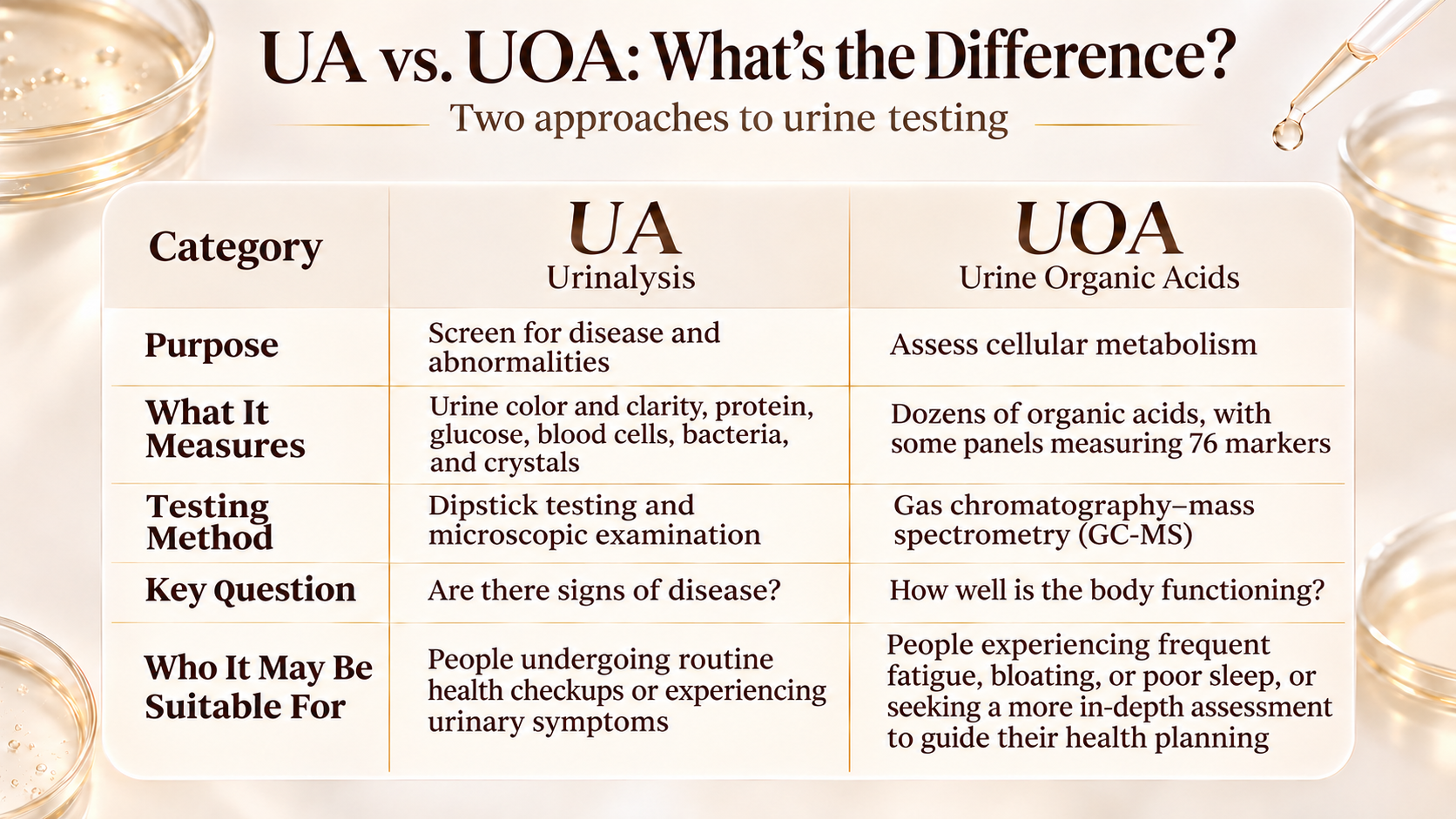
So these two tests aren't competing with each other; they work best together. A UA screens for disease, while a UOA helps uncover the root cause of symptoms that haven't yet developed into disease.
The main benefit of a UOA is that it gives you a picture of multiple body systems from a single urine sample. People with symptoms that have no obvious cause, such as chronic fatigue, brain fog, bloating or mood swings, get data that can be analyzed further instead of having to guess. Here are the five areas a UOA helps assess.

A UOA shows whether your body actually has enough vitamins to do its job, not just how much you're taking in. B vitamins act as helpers (cofactors) for the enzymes involved in metabolism. When they're lacking, certain compounds build up and more of them are excreted in urine. Example markers:
This information helps the doctor recommend personalized supplements more precisely, adding only what your body actually needs instead of taking a multivitamin without knowing what you're short of.
If you get enough sleep but still feel exhausted, the problem may lie in energy production by your mitochondria. This takes place through the citric acid cycle (Krebs cycle), the hub that produces most of the body's energy (ATP). Intermediates from this cycle, such as citric, succinic, fumaric and malic acid, spill over into the urine, where they can be measured.
When energy production stalls at a particular step, the compounds at that step tend to be abnormally high. For example, elevated succinic acid may be linked to reduced mitochondrial function or to deficiencies in iron, vitamin B2 or CoQ10. This helps the doctor pinpoint the cause of fatigue instead of simply putting it down to getting older.
Your gut sends signals out through your urine too. Bacteria and yeast in the gut produce distinctive compounds that are absorbed into the bloodstream and then excreted by the kidneys. A UOA can therefore show whether your gut microbiome is in balance, through markers such as:
These results can help explain chronic bloating or digestive upset that standard tests often fail to pick up.

Once the body has used its neurotransmitters, it breaks them down into metabolites that are excreted in urine. A UOA can therefore help assess whether your key neurotransmitters are being produced and used in higher or lower amounts.
Serotonin is also the precursor to melatonin, the hormone that helps you sleep. An imbalance in this group may therefore be linked to both mood swings and poor sleep. Keep in mind that these values don't measure brain chemicals directly; they are metabolic traces from the whole body, so a doctor must always interpret them alongside your symptoms.
The final group of markers shows how well your body's detoxification system is working. A key marker is pyroglutamic acid: high levels may mean your body isn't producing enough glutathione, the main antioxidant the body makes on its own. Meanwhile, 2-hydroxybutyric acid tends to rise when the body is under oxidative stress.
In an age when we face pollution, processed food and stress every day, knowing whether your detox system can still keep up helps you plan your recovery before the damage builds up enough to cause symptoms.

Test results are only useful when they're translated into a care plan you can actually follow. UOA results are in-depth data that must be read alongside your symptoms, health history, diet and any medications or supplements you take, because many markers fluctuate depending on what you eat before the test. This test should therefore be done under a doctor's supervision, from preparation through to interpretation.
At Design Wellness, we use test results as the starting point for personalized health design. Dr. Wimlak Suedee (Dr. Wim), a physician with more than 22 years of experience in integrative healthcare, interprets your urine test alongside your other results, then creates a plan covering nutrition, targeted vitamin supplementation, gut care and sleep recovery, tailored to your body and lifestyle.